"you are the salt of the earth. but if salt loses its saltiness, how will it become salty again? it's good for nothing except to be thrown away and trampled under people's feet. you are the light of the world. a city on top of a hill can't be hidden."

matthew 5:13-14

Saturday, August 20, 2011

don’t die with your smiles

Well, I have less than two weeks left in Mongu. Although I knew this time would creep up on me, I’m still not prepared for it! Suddenly I shifted from telling people at church, “I still have a few months left yet – no worries, we’ll have plenty of time to hang out and get to know each other!” to hearing myself say, “I just have two Sundays left…” What do I say when friends ask me when I’ll be back to visit them in Africa? How do I respond when they ask me to stay longer? Although Skype and Facebook are (I can’t believe I’m saying this…) lifesavers when it comes to keeping in touch across oceans (literally), I honestly don’t know if I’ll ever be able to see my friends and my kids here in Mongu in person again. And that’s been hard to come to terms with.

It’s bizarre, this four-month-medium-term-intern thing. If you come for two weeks, great – you can run on adrenaline, make acquaintances with the locals knowing that they’re impacting you so much more than you could ever impact them, and go home on what we called in middle school a “camp high.” If you stay any longer than eight or nine months, you start to make some roots, dig your heels in, and truly be enveloped by the culture and the people. You find a rhythm (hopefully) that includes regular Sabbaths – you can develop a sense of how much you can take and when you need to hide from the world, and you’re in a place long enough that moderating work with rest is acceptable and, frankly, required. But four months? I’ve just started making friendships built on genuine trust. I finally have “How is your morning, My morning is good” (“Mu tozie chwanie, Mu tozie handi”) and a few other essential siLozi phrases perfected, and I’ve dropped all my direct objects and prepositions like a true Zambian. I just figured out how to walk to church from any elementary and secondary school in Mongu, for crying out loud. And now we leave?

After church this past Sunday, Felix, the owner of the restaurant at Hope Church that I wrote about a few weeks ago, told Bryan and me something that has really helped get me through the spiritual and emotional funk of trying to tear myself mentally away from the kids and friends I’ve made in Mongu. He simply said, “It helps to remember that we’re all family – we’re all connected in Spirit. We never really say goodbye.” Amen to that!

most of us interns at our house :)

Aside from mentally weaning myself away from Mongu and, of course, making plans for seeing Victoria Falls and a few churches in Capetown after we leave, it’s been tough for me to find joy recently. Apart from the consistent destitute poverty and shocking immorality all around us (which is frankly enough to bring anyone to tears), these past few weeks have just seemed extra-hard. Chuma’s (a VOH student’s) mashasha house, which is just outside the compound, burned down last week because her dad came home drunk one night, started beating her mom, and knocked hot charcoal into the walls of their hut. The teachers of VOH have yet to find where she’s now staying. I also just found out that a stray dog I made friends with on the way home from Shoprite got beaten to death just outside Mutoya’s gate. Not nearly as upsetting as just plain annoying, I got my fifth and sixth proposal today from guys who said they’d just “love to marry a makua.” As of this past weekend, Bukolo, a malnourished six-year-old child whose family is now staying at the Save-a-Life Malnourishment Center so she can get enough food at hourly intervals, hadn’t smiled since she’d been admitted to the program a month ago. And we also just found out that Gift, one of the babies on the weekly feeding program at VOH Clinic, died yesterday morning from fever at his home. Baaaah – all so close to home.

But it hasn’t been just an external battle that’s pulled me down recently. (Confession #1 – yet another “duh, Stephanie” moment – here we come.) In all the bustle of trying to find ways that I can be of tangible help here, I think I fell into busyness and into the trap of sharing God’s love so frantically that I forgot to remind myself that fundamentally, first, and foremost, I am loved. That I love because God first loved me. That I can’t possibly love all those around me with my own love – it just ain’t gonna work! – but that it’s God’s love for me which naturally overflows onto everyone I meet. Theoretically and theologically, I understood that concept years ago. Mentally, yes, I know that God loves me as his beloved and I’m simply a conduit of his love. Yet truly believing it in my heart as I do in my head is the difficult part, especially in a place where there’s so much to do and (seemingly) so little time to sit down and reflect on where that love gets its start.

Ethan, Elijah, Bryan and me at Hope Church

Confession #2: In the process of discovering how I’d misplaced my joy, I also realized how results-oriented I am. A couple weeks ago, this guy Enoch and I spent about four hours scrubbing and washing 15 kids’ tables and 60 little plastic chairs, all begrimed and dusty from being in the Village of Hope orphan school tent at the top of the hill for the last couple of months. Our job was to have them clean so they’d be ready to move into the new school building when it was finished. We started out just great with a couple of clean buckets of water, soap, an old sponge, and three or four rags. About an hour in, though, the tank at the top of the hill ran out of water (a more and more frequent occurrence nowadays). We soon found ourselves remarkably dirty, scrubbing dirty tables and dirty chairs with a dirty sponge and dirty rags, working just as hard as before but now essentially just moving dirt around. We rinsed the tables and chairs off and allowed them to dry before we covered them with plastic, but we knew it would only be a matter of minutes before dirt would cover them again, possibly making them even blacker than before since they were all still wet. I just remember thinking, “Why are we doing this…why even bother?”

I’ve felt that way about a lot of things in Mongu while I’ve been here. Things are just harder in so many ways, and I sometimes spend ten times the amount of energy, effort, and time than I budget only to achieve the same, or worse, result than I initially expected. At times I feel like I’m hitting a brick wall when I’m teaching kids who don’t understand my accent or when I’m waiting for construction materials for the school, clinic, and Malnutrition Center so they can finally get up and running. For the first few weeks with Bukolo, she moaned constantly and looked absolutely miserable – she had maybe a 50/50 chance of surviving through the month. There are so many factors against us here – broken communities, families, and homes, and of course, the incredible poverty that affects all parts of life. Where are the results of all our pain and effort? Where’s that quick fix you look and hope for when you know good people are doing good things?

 Bukolo one month ago, body swollen and skin breaking from malnourishment

Bukolo (6 years old), Bukolo's ima (mom), and her two younger brothers, Timothy (2) and Tutu (4), taken a few weeks ago

I think I’d started to feel a little bit like that dirty rag I used to clean those tables and chairs. What was I doing here? What possible good could I, an intern who was going to leave in just a few months, give to a town so broken and in need? Each time I scrubbed, I dunked myself back into dirty water, all to come out ready to scrub again, even blacker and dirtier than before. And the tables and chairs weren’t getting clean.

Again (always…), I realized in my heart that I desperately needed to remember God’s love for me – to dunk myself into a clean bucket of suds, if you will. I need God to recharge me rather than me try to recharge myself. As far as what I’m doing here, my work is not nearly as important as my consciously dedicating it to God. It doesn’t matter that what I do doesn’t yield instant results. This is Africa…microwave solutions just don’t happen here. It’s okay that the kids didn’t understand all of my lessons last term. It’s okay that Bukolo hadn’t responded to my efforts to make her smile and feel welcome at the clinic, her new home. It’s okay that those tables and chairs went right back to being as grimy as before. What matters is that I taught God’s children, I’m loving on Bukolo, and I’m not forgetting that God’s kingdom is on its way – it’s here! When we legitimately believe in our hearts that Jesus has already conquered the world AND God doesn’t judge worthiness based on what we accomplish, then we find that we are his beloved.

Reminds me of a fav C.S. Lewis quote from the Screwtape Letters:
“It is during such trough periods, much more than during the peak periods, that it is growing into the sort of creature He wants it to be…Do not be deceived, Wormwood. Our cause is never more in danger than when a human, no longer desiring, but still intending, to do our Enemy's will, looks round upon a universe from which every trace of Him seems to have vanished, and asks why he has been forsaken, and still obeys.”

Yet even while there’s still brokenness here that makes it hard for me to see that I’m not truly forsaken, God does show that his kingdom is already here in huge ways! He built a school for orphans (the first two of four new classrooms for VOH are finally finished – praise God! – and those tables and chairs look beautiful in them!), is finishing up the VOH Clinic, and opened the Malnutrition Centers so it can begin to host feeding programs.

I’ve also learned, though, that even when we don’t see the instant and perfect results that we pray for, God still gives us tiny glimpses of his glory and love along the way to encourage us in our service, energize us to be kingdom people, and so we can experience and appreciate every small success. For me, the most recent series of small joys have been with Bukolo and her brothers at the Save-a-Life Malnutrition Center over the past week. Three days ago, Bukolo didn’t let me get within a foot of her, she was constantly moaning, had poor appetite, glared at everyone, and was lethargic. Now she reaches for me to pick her up, snuggles close to my chest for warmth and safety when we walk down to the showers at the base, giggles as I tickle her all over, plays house with me as I feed her paper food on paper plates with a paper fork, learns patty cake, lets me hold her arms to teach her how to walk again, climbs with me on the jungle gym, eats well, and gives me daily haircuts. It’s miraculous.

One of Bukolo's first smiles since she's been admitted to the Clinic

Tutu, also all smiles!

 Bukolo's appetite has gone way up since she's been here

Bukolo still has a long ways to go, as do the school buildings, the center, and the clinic – but it’s been these small glimpses of joy over the past week that have allowed me to rediscover God’s love working through me. When I hold Bukolo, I feel so much love for her that it’s overwhelming. I’ve never felt so much love surge through me as when she first let me pick her up. There was no way that was all mine – it was God’s love Bukolo her working through me, reminding me along the way that God loves me just as much as he loves her. It’s a giddy, supernatural kind of joy. Outrageous, contagious, out of control – yep, that’s God’s love for us.
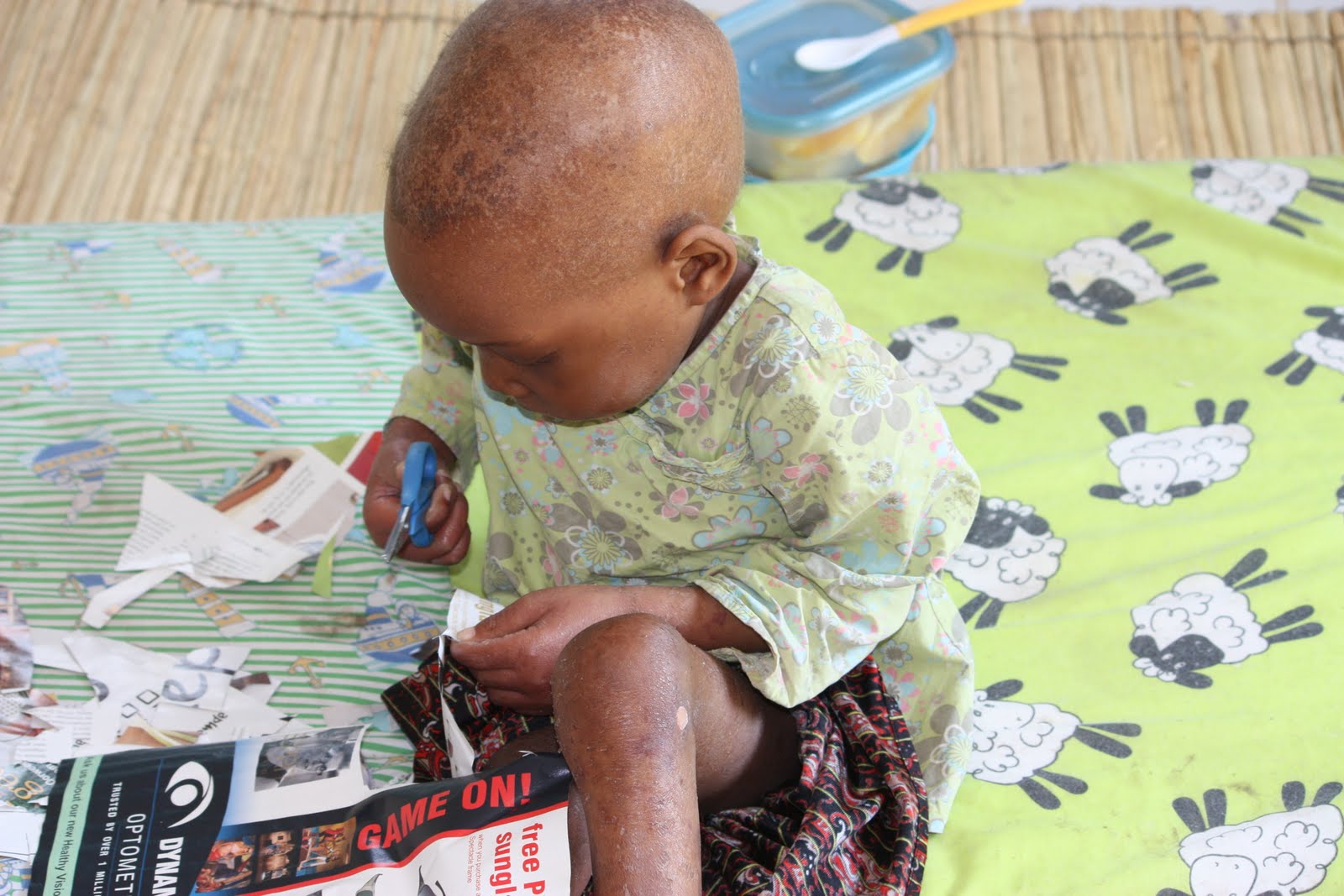
Bukolo cutting out pictures from old magazines for her collage


Tutu trying on his new hat


What pictures should we pretend with now?

So if I’ve learned anything in Africa, it’s technically what I’ve already known: that God’s love is the absolute source for everything, this joy bubbling up inside me is a natural consequence of his love for me, and life is about people, not results. Read out of context, that sentence is just another “duh, Stephanie” moment…but experiencing it daily is life-giving. So I encourage you to remember that God’s love is where everything get its start and to find that joy too.

For the remainder of my time here, I’ll continue hanging out with Bukolo, her brothers Tutu and Timo, and her mom at the Malnutrition Clinic, preparing food every 2 hours, cutting out pictures for collages, drawing each other with crayons, coloring Little Mermaid coloring book pages, and strengthening Bukolo’s legs and arms at the playground. Bryan, Catherine, Wes, four translators, and I plan to head out to the floodplains for the last time this weekend, hopefully for the whole week. We’re traveling by boat to Liloyello, and there’s been quite a bit of friction with Christians coming there in the past…so prayers for softening their hearts and having the Holy Spirit speak through all of us when we’re there, please! On August 30th, Bryan and I will head out from Mongu for Livingstone, to Capetown soon after, and finally back to the States on September 13th.


Bryan and me gettin tourist-y

To quote Felix once again (I can never do it enough), “Don’t die with your smiles.” I hope and pray that yall are all doing beautifully and that this summer’s been as wonderful, challenging, and stretching for you as it’s been for me. All my love and in his peace,

Stephanie

Friday, August 5, 2011

welcome to the dog days of summer!

Hey yall!

I can’t believe it’s August already. It’s AUGUST. Already. I just walked across that stage at graduation…where’d the last 3 months go?! I know many of yall are headed back to college or to grad/med school – YAY and best of luck as yall wrap up the summer and prepare for an awesome new academic year!

Here, schools let out this week for a month-long holiday. It’s getting so darn hot here that schools probably need to give their students a break just so they won’t fall asleep in class every afternoon! We just finished up at Village of Hope orphan school on Wednesday, and the teachers took the rest of this week to scavenge through all the school’s materials to salvage at least a few things that can be used next term. There’s so much sand, dirt, and dust up there at the tent (VOH’s temporary home) that the tent’s turned from a pretty blue entirely to gray, and you start sniffling when you get within a few meters of it. Sand got into everything this term – all the cabinets, books, stuffed animals – and all the plastic that can be washed definitely needed to be! So, we had a scrub party all day today to get everything back to its (semi-) original color. Meanwhile, the two new school buildings with VOH’s four new classrooms are still being built, but construction’s going a bit faster now that there’s a new crew and more interns are available to help out during the day. The goal is to have one done by mid-August and both completely finished by next term (September 7th). It’ll be a lot of work, but hey, God works miracles!

Thursday was the last day that the Wycliffe translation school at Mutoya met as well, so a few of the other medium-term interns and I took the opportunity to sit in on classes yesterday morning. About 35 Zambians representing five different languages from all over the Western Province and 8 or so trained Bible translators from just about everywhere in the world have been staying at base camp for the past 3 weeks (they leave today and tomorrow). They gathered together daily at VOH school’s old home with the joint goal of translating the book of Luke and the subtitles of the Jesus Movie from the original Greek to the visitors’ native languages. The time frame? Just four years. Four! And they only meet for 3-week intervals three times a year: March, July, and November. Not only that, but all five of these languages hadn’t ever been written down before this past March – not even their alphabet! By this point with only two sessions under their belt, they’ve translated into their own languages two stories from Luke, the one where Jesus stayed in Jerusalem’s temple when he was young and the other the parable of the good Samaritan. 

It’s ridiculous how intelligent the village visitors are and how quickly they’ve picking up on the science of translation, especially given that half of them grew up in villages that didn’t have a high school. The Wycliffe Bible translators are amazing as well. One German couple spent 20-something years in Alaska inside the Arctic Circle helping Native Americans develop a written form of their language, compile a dictionary, and translate the Old and New Testaments into their local dialect. After about ten years in Nigeria doing the same with villagers there, they felt called to work alongside the Zambia Project with the Seed Company (the organization that oversees and coordinates the translators) in Mongu. We talked about all their travels and experiences over tea as if their lives so far were completely ordinary – it was crazy that we were even sitting in the same room! Later on that morning, I talked with another translator from the Sudan who said that many of the men and women he’s worked alongside with Wycliffe had engineering and math degrees (like himself). After just a morning at the school, I can definitely see how translation is a science – their approach and execution is entirely methodical and you really do need to love organization and, well, engineering. And Greek. ;) So many things that I want to do in life, so little time!

For the next three or four weeks at Mutoya, I’ll work alongside Lihana (a medical missionary with the Zambia Project) and Ivy at the Village of Hope Clinic and Save-a-Life Malnutrition Center (check it out at zam.co.za, listed under “Projects”). There’s so much that needs to be done to the two buildings themselves that it’s really tough to admit any patients this winter, but Lihana and the team are accommodating as many children as possible while working their tails off so the centers can operate at full capacity. Everything’s harder in Zambia…just like the construction for the school buildings at the top of the hill, it’s taken months longer than expected to finish the buildings (they were both supposed to be completed this past March…can you imagine?). The windows are just now put in, so we can finally start moving things into the clinic without the fear that they’ll be gone by morning. Tons of baby clothes, bedding, and medical supplies still need to be sorted and organized and the water supply is sketchy at best, but things are coming along!

From what I can tell so far, the Save-a-Life Center hosts a feeding program for malnourished patients on Tuesdays; Ivy and Kate make home visits every day; and Lihana admits children at the clinic throughout the week. Starting next week, I’ll work with Ivy and the malnourished kids in the mornings, and in the afternoons I’ll likely help Lihana organize supplies, sort through donations, set up beds, work on the plumbing, paint…basically anything we can do to get the clinic and center finally finished up. I’m so excited I’ll get to be a part of it! 

I hope yall are doin so wonderfully, and know that yall’re always in my thoughts and prayers! I miss yall and see you soon!

P.S. More things I’ve learned about Africa since June…

28.If you change your accent to match that of the locals, they can actually understand you (sometimes necessary for South Africans and Australians as well!).
29.Say anything to a kid in English and they’ll answer, “fine – and – how – are – you?”
30.Texting is a worldwide obsession.
31.When Shoprite’s bread maker is broken (a biweekly occurrence), all of Mongu suffers.
32.When the electricity goes out, have a dance party with your roommates (using headlamps as your disco balls are an absolute must).
33.Dessert is “pudding,” pudding is “pudding,” Jello is “jelly,” jelly is “jam,” cookies are “biscuits,” biscuits are “biscuits” (we think), fritters are “scones,” crepes are “pancakes,” real pancakes are for dessert (or “pudding,” if you’ve kept up), “just now” means anywhere from “in a few minutes” to “in a few days,” dog as an entrée is “small beef” (ew), and near is “fa.” Who knew?
34.Cold showers are no good no matter what country you’re in.
35.You can actually SEE the Milky Way out here!
36.Sandstone makes a better pumice stone than anything you’ll find in the swankiest salons.
37.When you run out of Band-Aids, super glue does the trick.
38.Interns in Africa turn into professional color printers and copiers at a minute’s notice. We’re capable of creating anything from 80 double-sided invitations for an end-of-school bash to 200 glittered invites for a Women’s Day at Hope Church to 400 invitations for Kids’ Fun Day.
39.Drawing, coloring, and laminating can indeed be mission work.
40.Both morning and afternoon tea are critically necessary.
41.Cream soda in the rest of the world is frightfully green.
42.Making friendship bracelets really does make new friends.
43.12 hours’ notice for an event is completely acceptable.
44.You learn how to convert Celsius to Fahrenheit, centimeters to inches, kilograms to pounds, mL to fl. ounces, and kwatcha to USD like it’s your job. Then you get over it and start wishing the US had adopted the metric system.
45.Trees and mashasha fences may be compromised, but Toyota Highlanders can indeed fit into six-foot wide walking lanes.
46.The best way to transfer a note safely to a child’s parents is to staple it to his shirt.

Love yall!

Stephanie :)

Saturday, July 30, 2011

mulimu ki yo munde

"Mulimu ki yo munde, na caa cao fela. Na caa cao fela, Mulimu ki yo munde!"
God is good, all the time. All the time, God is good! 

It's amazing how no matter where you are, kids will be kids. Here I am, in the smack middle of Zambia with precious boys and girls from ages 4 to 13 who have led such incredibly difficult lives already, yet they act so similarly to any other kid I've ever known. If they see that you have "plasters" (Band-Aids) in the classroom, they'll point out week-old scrapes on their knees, feet, and elbows to win sympathy and (ultimately) a prized plaster to brag about to all their friends. If they get hurt when you're looking, it's all tears - but if they hurt themselves around their friends, they'll just shake it off! They still want to be first in line for everything, get the largest and best servings at lunch, and show off their colored David and Goliath coloring sheets to every single one of the teachers. I've learned that attention spans of first graders are just as short in Africa as they are in America, but thankfully, "Bubbles!" works just as well (puff out your cheeks with air and hold - they'll stop chatting and screaming and, as an added bonus, they're so amused by how their friends look that they'll stop hitting them, too).

Some things about the kids and what they do here are very different, though. Instead of the kids enjoying a mid-morning snack, we as teachers hope that we had enough breakfast to serve them that morning (and that we'll have enough lunch to keep them full until, for some of them, the next morning). Instead of peanut butter sandwiches, we serve porridge and rice (and on Fridays, nshima with beans and cabbage - a huge treat!). When we run out of water at the top of the hill, we let out early. Instead of freezing in too-cold classrooms with cranked-up AC in the afternoons, we open up the tent flaps and hold on to our papers, teaching materials, and flip flops for dear life. Also, everyone (adults included) add "ee" to everything: five-ee, search-ee, Kate-ee. For some reason, though, they take the "ee" off of "Stephanie" - instead, I'm just Stephan. Every time I introduce myself, I get a little bit of a chuckle...apparently that's only a guy's name around here. :) Took a little while to get used to, but everything's finally become normal to me now!

One of the cool things about bein with pre-K to 3rd graders in all day is that you pick up a lot of really cool songs and tips - like how to make fritters (fried bread balls) or what will happen if you don't wash your hands before you eat. Try em out - I promise you'll enjoy these little tastes of Africa. :) 

Auntie Jane's Fritter Recipe

Auntie Jane is our all-star fabulous cook at VOH. She's actively involved at Hope Church, in the community, and - of course - with the Zambia Project. These balls of goodness are amaaaazing - I'd imagine they're heaven with honey and powdered sugar drizzled on top and I know they're good with peanut butter and jelly, but up at school we love them just as they are. Many Zambians get their entire income from selling these to passers-by on the roadside.

Combine:
2 cups flour
2 tsp baking powder
3 tbsp sugar
pinch salt
2 cups water
...and mix together until you get a sticky dough. Drop large rounded spoonfuls (2-3 inches diameter) into simmering cooking oil, turn when browned, and take out when they look golden. Voila! Hot or cold, they're good-uns. :) 

Wash Your Hands-ee (to the tune of Frere Jacque)
The first time I saw the kids do this one I just about died!  

Wash your hands-ee, wash your hands-ee, wash your hands-ee before eating. (Motions: Act like you're scrubbin your hands after coming in from playing outside.)
Wash your hands-ee, wash your hands-ee, wash your hands-ee before eating. 

Stomach pains-ee, stomach pains-ee, stomach pains-ee just now. (Bend over looking sick...)
Stomach pains-ee, stomach pains-ee, stomach pains-ee just now.

Call the doctor, call the doctor, call the doctor just now. (Dial up on your imaginary phone.)
Call the doctor, call the doctor, call the doctor just now.

Operation! Operation! Operation just now. (Slash your stomach open!)
Operation! Operation! Operation just now.

Feeling better...feeling better...feeling better just now. (Just act like you're feeling better. ;) )
Feeling better...feeling better...feeling better just now.

Bye bye, doctor. Bye bye doctor. Bye bye doctor just now. (Wave goodbye over your shoulder as you head back outside again!)
Bye bye, doctor. Bye bye doctor. Bye bye doctor just now. 

Row, Row, Row Your Boat
This one's with a little African twist. :) 

Row, row, row your boat gently down the stream
If you see a crocodile, don't forget to scream. AAAAHHHHHH!!!  

And here's just a few of my favorite songs that we sang in the bush, especially in Nangula and Nalulau (and I can't promise that any of these words are spelled correctly - Lozi/English dictionaries are few and far between!): 

Hakunah 

Hakunah ya swana ni Jesu. Hakunah ya swana ni Jesu!
Hakunah ya swana ni Jesu. Haku, hakunah!
La mata...

La mata, mata, cuale, cuale.
La boto loha, cuale, cuale.
La bata, bata, cuale, cuale.
Haku, hakunah!

There's no one, there's no one like Jesus. There's no one, there's no one like Jesus!
There's no one, there's no one like Jesus. There's no one, there's no one like him. 
We walk-ee...
We walk-ee, walk-ee, here, there.
We turn around-ee, here, there.
We search-ee, search-ee, here there.
There's no one, there's no one like him! 

Rapheal's Song
Rapheal, one of our translators in Nalulau, sang us this song every morning as we were boiling water for coffee and making Jungle Oats to help us ease into the day. 

I wake up in the morning and see the sunrise
I feel the Lord's joy in my heart.
I wake up in the morning and see the sunrise
I feel the Lord's joy in my heart. 

(Chorus)
Oh Lord, I need your guidance
In all things I do and wherever I go. 
I need your love every day
In the long way I still have to go.

I see flowers around me and birds of the sky
I feel the Lord's joy in my heart.
I see flowers around me and birds of the sky
I feel the Lord's joy in my heart. 

(Chorus)

All angels of heaven are kneeling down
All creatures are praising the Lord.
All angels of heaven are kneeling down
All creatures are praising the Lord.

(Chorus)


Ki Mulena 

Ki mulena, mulena wa mulena. Ki mulena! [Translation: He is king, king of kings. He is king!]
Ki mulena, mulena wa mulena. Ki mulena!

Ki yo munde, mulena wa mulena. Ki yo munde! [He is good, king of kings. He is good!]
Ki yo munde, mulena wa mulena. Ki yo munde! 

I miss all yall so much and I can't wait to see yall in person! Thank you as always for your thoughts and prayers - we need them (it's our last week this week at VOH!) - and know that you're in my prayers as well. All my love and in His peace,

Stephanie 

Monday, July 25, 2011

david vs. goliath

Hey, yall!

I’m finally getting back into the swing of things at VOH after my 2-week respite and, lo and behold, this term’s almost over! We only have another 8 days of school left with the kiddos, which means that us teachers are getting the kids prepped for their performances for their parents/guardians next Wednesday, packing up the tent (i.e. de-sanding everything that’s salvageable and tossing the rest) so we can easily move into the new classrooms (cross your fingers that they’re actually going to be finished by September), and of course, doing student assessments. Instead of taking exams, the students are “assessed” by their teachers on their abilities to write, read, speak English, count, identify shapes, do math...stuff like that. It’s taken all week for Stephen, Jane (another medium-term intern, also from Texas!), and I to evaluate all the 1st, 2nd, and 3rd graders’ proficiencies, mostly because of the amazing backstories Stephen tells us about each child. Stephen knows every one of these kids as if they were his own, from the village they were born in to who they hang around with after school. 

From a teacher’s perspective, one of the worst things about these kids’ lives at home is that where they sleep, the cohesiveness of their families, their parents’ educations, and the nature of their communities funnel directly into their abilities to learn and perform well at school. Most of the kids who attend Village of Hope Orphan School live with single parents, grandmothers (“kukus”), or guardians in the villages close to Mutoya. Although the Zambians who live in town certainly don’t live in luxury, the lucky few have access to electricity or at least solid walls on their houses or flats. Life for the villagers, on the other hand, is quite different. The best of bush houses are made of mashasha (bamboo mats) and twine, the stove is the fire outside, and in the winter (as it is right now in Zambia), they freeze at night. To really understand the community’s values and what’s considered “normal” everyday behavior in the bush, though, I needed Stephen.

Stephen’s heart cries out for the children who live in the villages communities in and around Mongu. While he’s been teaching village kids at VOH and in other school systems, he’s learned that the communities that the children grow up in drastically affect their performance in class – and unfortunately, in the bush villages, it’s usually for the worse. As Jane and I talked to Stephen about the performance of child after child, we learned through individual stories that many of the students’ “families” were actually congealed fragments, the mom often working two or three small jobs to support five or six of her children, all born of different fathers. Sleeping around was a part of what Stephen called “the order of the day” – and why not? If you need nshima and fish for you and your children, and a man offers you food in exchange for something, what an easy fix that is. If he doesn’t want your kids to sleep in the same house as you and him (mashasha houses often have just one room, but a curtain of extra blankets can act as a divider if you have enough of them), then your children sleep outside. If you depend on him for every type of support, you don’t have to care about your children – so you either send them across the village to their grandma’s (kuku’s) or you let them wander. If you have a boy, perhaps the worst that can happen is he’ll get really good at fighting with the other boys in the neighborhood. If you have a girl, though, her wanderings will make her prey to all the men and boys in the village just as you were when you were young. But what’s the big deal? It’s a part of life. It’s just “the order of the day.” 

Not every family looks like that, but Mwangala’s and Nayoto’s do. Some parents are simply uneducated and don’t know how to help their kids in their studies at home, or they simply don’t care enough to support them in what they have learned. It's simply village culture. A few weeks ago I asked why we didn’t assign the kids homework or at least let them take their workbooks home so they could practice their English and math. Stephen told me that they’d tried that – but the handouts and books never made it back to school. Parents or guardians at home would see the paper and think, what perfect fodder for tonight’s fire for dinner or, I can use that to roll up a cigarette. 

In my past experience, the opposite has always been the norm: home was where my friends and I always found encouragement, love, and enthusiastic support. Our parents (or the government, at least) cared whether we showed up to school or not. Sexual or physical child abuse was something that you only heard about on the news – perhaps a tragic story of some dilapidated family that lived in a town far, far away. Sibling rivalry was bickering over who stole whose favorite tank top, not which sibling’s father was better than the other’s. A decline in a student’s performance was attributed to drugs, alcohol, too much TV, or hanging out with the wrong crowd. Here, it's more likely because a mom is trying as hard as she can to feed her 5 kids with whatever she can get from selling herself or fried bread on the roadside (the commodity depending on the customer). It’s not okay that life in the villages of Africa is like it is when there are millions of good, giving, caring people who have the resources and hearts and abilities to fix it. So what can we do?

I’ve seen pictures of starving African children and I’ve read statistics on how corrupt governments can be. Usually I’m barraged with images and facts in commercials or magazines, and the fix-it-all answer is always the same: “Send money to my organization that you have no vested interest in, I’ll take care of the details, and just trust me that your money’s used to its greatest extent to completely reverse the trajectories of these peoples’ lives.” Quite honestly, that plea might be the most effective way of inciting a response from people who have too much and who live an ocean away from starvation, abuse, and true need. The Zambia Project’s website does the same thing (it only costs $1 a day to provide an orphan with all they need to live and thrive in a loving home, and just $1 more to send them to school). I understand why needs are presented like that – tear-jerking stories and heartbreaking pictures have to be shared, especially when your own heart is so broken from the real thing. Apart from getting people to come to Africa and see the institutional brokenness here themselves, there seems to be no other way to bring actual change to people who desperately need it than to ask for support. 

What I’m starting to see, though, is that money sent in an envelope can only take you so far (this is another one of those “duh, Stephanie” moments). More money funneled into one of these village communities via the Zambia Project will absolutely help build proper houses for families who live under piles of rubbish piled on top of itself (Moonga’s house that I wrote about in my last blog is a perfect example). Money is desperately needed for building materials and construction crews to get the school building finished on time for next term. Money is the primary bottleneck to every project that the Zambia Project takes on, from drilling a well for a village that’s never tasted clean drinking water to building a security wall around the school so the kids, classrooms, and teaching materials are safe. Yes, money is important. But money just can’t fix everything. 

When Stephen and the rest of the teachers teach their students every day, they wage war against the institutional brokenness in each child’s life. Although a check can buy much-needed teaching resources and help build a school (which is AWESOME), it can’t erase every barrier that keeps kids at VOH from reaching their full potential. When I’m trying to teach Mwangala how to write her name correctly, I push against the permanent damage that her mother, father, and community have done to her. We’re swimming upstream, fighting against what malnutrition at a young age has done to these kids’ brains already and what their current hunger is doing to them now. We physically combat the terrible examples that their communities have taught them by being the best examples of God’s love that we can be. We teach in “Kid Power” that physical and sexual abuse is wrong and shouldn’t be tolerated, while we know that half the students’ lives are directly affected by it and they really have no power against it. At parent-teacher conferences next Wednesday, Stephen will sit down with guardians who don’t care whether their kid shows up for school or not, much less how they’re doing in math.

It’s critically important to remember that it is not the people in these communities who are the problem. What Jesus said hits the nail on the head: “For our struggle is not against flesh and blood, but against the rulers, against the authorities, against the powers of this dark world and against the spiritual forces of evil in the heavenly realms” (Ephesians 6:12). Evil is real here, and I see its effects in the kids’ eyes every day. Sin and corruption worm themselves into every aspect of these kids’ lives, just like the sand gets even under their fingernails and in their noses and between their toes. Mongu doesn’t just need a check or a wire transfer. It needs more willing Christians to invest their lives into its people, teaching them how to walk in the light, the Way, the only real way to live at all. We need to do what Christ told us to do – “go” and feed the hungry, house the homeless, visit the sick, teach the orphans, and fight like there’s no tomorrow against the values of this world and what’s considered “normal” in the villages of Mongu. That’s how we wage war.

There’s just so much fighting we have ahead of ourselves, though. What’s helping me make it through is remembering that Jesus has already conquered the world. This world and its desires are passing away, yes, and it’s also taking along with it its pain, sickness, hunger, hiding, and darkness. But while we still see real suffering in the world, we as Kingdom people are called to bring a little bit of God’s Kingdom down here to earth. Sleeping around with men for food and money might be efficient and practical, but we need to teach that true rewards come to those who are faithful to God. We just need to trust that God will fix the world, and he’ll use our faithfulness to do it. When I look at the battles Stephen and Margaret fight in teaching these children every day, I marvel at how they can even bear to go on – don’t they know how much institutional brokenness they’re fighting against? But they are making a difference in these children’s lives, and God will use their faithfulness in serving Him to further his Kingdom and to bring himself glory.

Discussing kids with Stephen and Jane took all week, but now I feel like I know these kids more intimately than I ever thought possible. So although I sometimes would honestly rather just stay in the shade at the bottom of the hill all day rather than hike up to the tent, breathe in dust and dirt, and try to teach with little to no resources, I know that my faithfulness matters more than my comfort or cynicism. For some of these kids, school is the only consistent thing in their lives, and it’s the only place where they feel safe and valued and loved. It’s such an incredible feeling to walk to the bus stop and hear a child running up to me at ramming speed, yelling at the top of his lungs, “Teacher Stephan!” Maybe we as medium-term intern teachers at VOH don’t feel as though we’re making much of a difference in these kids’ lives – the battles we wage are so huge, and we’re only here for a blink! – but maybe God’s got this after all.